As outdoor living continues to grow in popularity, more homeowners, restaurants, hotels, and outdoor hospitality businesses are looking for attractive and practical ways to extend the use of their outdoor spaces during cooler weather.
A wood pellet patio heater is an interesting solution because it combines the natural appearance of a real flame with the warmth generated by burning compressed wood pellets. Compared with traditional gas patio heaters, pellet heaters offer a different heating experience, distinctive flame displays, and an alternative fuel option for outdoor spaces.
But how does a wood pellet patio heater actually work? What happens after you load the pellets? How does the heater generate warmth, and what should you consider when purchasing one for your business?
In this guide, GB-WARM, a patio heater manufacturer specializing in outdoor heating products, explains the working principles of wood pellet patio heaters, their main components, operating requirements, and key purchasing considerations for distributors, wholesalers, retailers, and commercial buyers.
1. What Is a Wood Pellet Patio Heater?
A wood pellet patio heater is an outdoor heating appliance that burns small, compressed wood pellets to produce heat and a visible flame.
Wood pellets are typically manufactured from compressed wood materials, such as sawdust and wood shavings. Their relatively uniform shape makes them convenient to store, transport, and use as fuel.
Unlike conventional fire pits that burn logs, a pellet patio heater is designed around the combustion characteristics of small wood pellets. Its combustion chamber, airflow passages, and fuel-loading arrangement work together to support the burning process.
Depending on the design, a wood pellet patio heater may include:
A fuel hopper or pellet-loading chamber
A combustion chamber
An air inlet and airflow passages
A flame display area
A heat-resistant glass tube or protective enclosure
An ash collection area or cleaning access
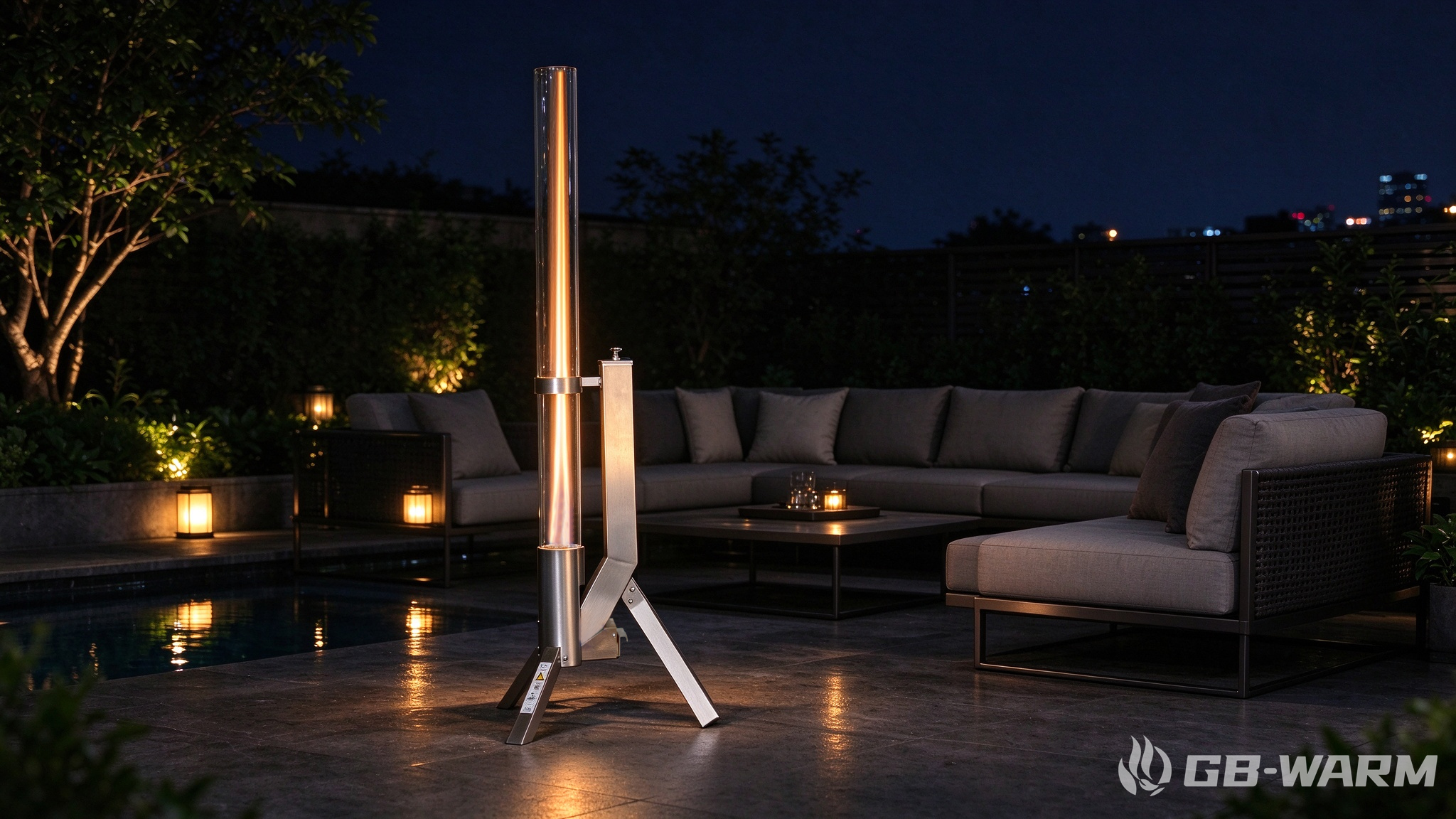
Not every model uses the same structure. Some heaters feature a tall, transparent flame chamber, while others use a compact, cylindrical, cubic, or rocket-style design.
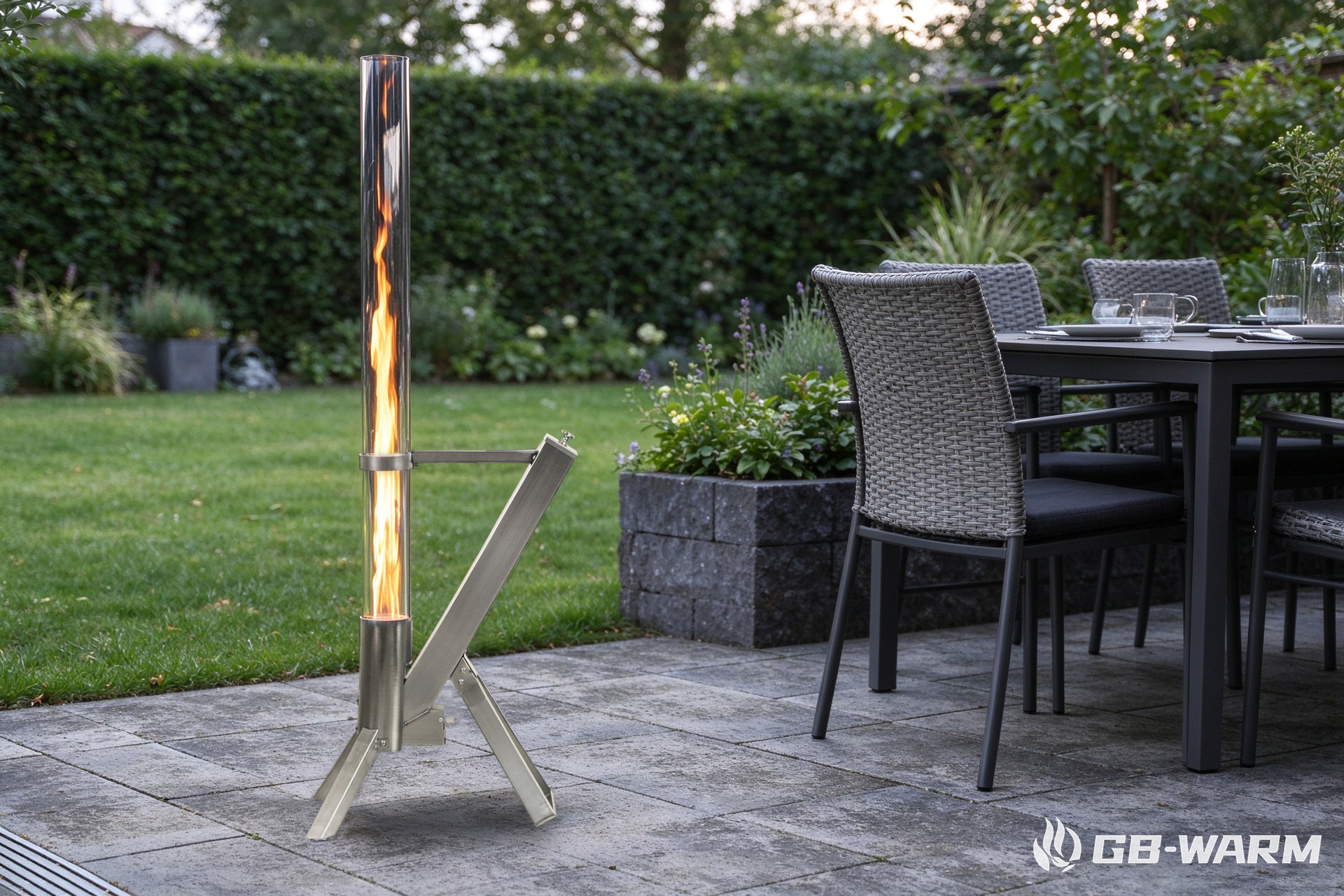
At GB-WARM, our pellet patio heater range includes different designs for outdoor heating and decorative flame applications. For example, the BPH-R80 Glass Tube Outdoor Pellet Heater combines a vertical flame display with a freestanding outdoor heater design.
For buyers, understanding the basic structure is the first step toward choosing a suitable model for their market.
2. How Does a Wood Pellet Patio Heater Work?
The working principle is straightforward: wood pellets enter the combustion area, ignite under suitable conditions, and release energy as they burn. The heater then transfers this energy to the surrounding outdoor environment.
Let's look at the process step by step.
Step 1: Load the Wood Pellets
First, the user adds suitable wood pellets to the designated fuel chamber or hopper.
The quality of the pellets matters. Dry, consistent pellets generally provide more predictable combustion than pellets containing excessive moisture or irregular amounts of fines.
Wet fuel may be more difficult to ignite and can produce less consistent burning. For this reason, wood pellets should be stored in a dry, protected location.
For commercial buyers, fuel availability is also worth considering. Before selecting a pellet heater for a target market, check whether suitable pellets are readily available from local suppliers.
Step 2: Supply Air to the Combustion Area
Combustion requires three essential elements: fuel, heat, and oxygen.
When the pellets are ignited, air enters the combustion area through the heater's designed air inlets. This airflow supports the burning process.
The arrangement of the air inlets and internal passages influences how air reaches the fuel and how combustion gases move through the heater.
A well-designed airflow system helps support stable combustion and a more consistent flame display.
This is one reason the internal structure of a wood pellet patio heater matters just as much as its external appearance.
Step 3: Ignite the Wood Pellets
Once the fuel and airflow are prepared, the pellets are ignited according to the manufacturer's instructions.
Depending on the model, ignition may involve an approved manual ignition method or another specifically designed system.
After ignition, the wood pellets begin releasing heat and producing flames.
Users should always follow the supplied operating instructions rather than assuming that every pellet heater starts in the same way. Ignition procedures, fuel-loading limits, and shutdown requirements can differ between designs.
Step 4: Maintain Combustion
After ignition, the heater continues burning the available pellets.
In a gravity-fed design, pellets move toward the combustion area under gravity. Other designs may use a different fuel-feeding arrangement.
The rate at which fuel reaches the burning area, together with the available airflow, affects the combustion process.
Several factors influence the heater's performance:
Pellet quality and moisture content
Combustion chamber design
Airflow and ventilation
Fuel capacity and feeding arrangement
Outdoor temperature and wind conditions
These factors help determine how consistently the heater burns and how much usable heat it produces.
Step 5: Transfer Heat to the Outdoor Space
As the pellets burn, energy is released as heat and visible flame.
Depending on the heater's design, warmth reaches nearby people and objects through radiant heat, hot-air movement, or a combination of both.
Radiant heat can warm people and objects directly, while hot air transfers heat through convection.
A glass-tube pellet heater also makes the flame part of the outdoor experience. The visible fire can create an inviting atmosphere for patios, terraces, gardens, restaurant seating areas, and hospitality venues.
However, outdoor heating performance depends on more than the heater itself. Wind, surrounding temperatures, seating distance, and the openness of the space all affect how warm people feel.
The key takeaway: A wood pellet patio heater converts the energy stored in wood pellets into usable outdoor heat through controlled combustion and heat transfer.
3. What Are the Main Components of a Wood Pellet Patio Heater?
For distributors and wholesale buyers, understanding the main components makes it easier to compare products from different manufacturers.
Fuel Hopper or Loading Chamber
This component holds the wood pellets before they enter the combustion area.
Its capacity and design affect fuel-loading convenience and how frequently users need to add fuel. Buyers should confirm the actual fuel capacity and operating duration for each model.
Combustion Chamber
The combustion chamber is where the pellets burn.
Its dimensions, materials, airflow arrangement, and resistance to high temperatures influence the heater's operation and long-term durability.
Airflow System
Airflow supplies oxygen for combustion and helps hot gases move through the intended pathways.
A properly designed airflow arrangement is essential for consistent burning. Insufficient or poorly distributed air can negatively affect combustion performance.
Flame Display Structure
Some pellet patio heaters use a glass tube to display the flame, creating a distinctive vertical fire effect.
For example, GB-WARM's BPH-R80 pellet patio heater features a glass-tube design intended to combine outdoor heating with a visually attractive flame display.
The glass and surrounding structure must be suitable for their intended operating temperatures. Buyers should also ask about replacement parts and maintenance requirements.
Housing and Base
The outer housing and base support the heater and contribute to its appearance, stability, and durability.
Depending on the model, materials and finishes may include stainless steel and other suitable metals or protective coatings.
For importers and private-label brands, material specifications, finish quality, packaging, and replacement-part availability are important details to confirm before placing a bulk order.
4. How Much Heat Does a Wood Pellet Patio Heater Produce?
Heating performance is one of the most important questions for anyone considering a pellet patio heater.
Heat output is commonly expressed in kilowatts (kW). A higher rated output generally indicates greater heat production under the specified test conditions, but it does not automatically mean a heater will warm a larger outdoor area equally well in every environment.
The effective warmth depends on several variables:
Rated heat output
Outdoor temperature
Wind exposure
Distance between the heater and users
Patio layout and surrounding structures
Fuel quality and combustion conditions
As a reference, GB-WARM's published specifications list the following two models:
| Model | Published heat output | Overall dimensions |
| BPH-R80 | Approximately 2.5 kW | 360 × 445 × 1295 mm |
| BPH-R80-E | Approximately 3.5 kW | 360 × 387 × 1295 mm |
Product specifications can be checked on the respective product pages for the BPH-R80 and BPH-R80-E.
These figures are useful starting points when comparing models, but buyers should request further technical details to determine which design is suitable for their intended application.
For restaurants, hotels, and commercial outdoor spaces, it is particularly important to evaluate the actual seating layout, wind exposure, expected operating conditions, and number of heaters required.
5. How Long Can a Wood Pellet Patio Heater Burn?
Burn time refers to how long a heater operates on a given fuel load before it needs to be refilled or stops burning.
There is no single burn time that applies to every wood pellet patio heater.
Actual operating duration depends on:
The quantity of pellets loaded.
The pellet consumption rate.
Fuel quality and moisture content.
The combustion chamber and feeding design.
Environmental conditions and operating practices.
For example, a heater with a larger usable fuel capacity may run longer than a smaller model if both consume fuel at a similar rate. However, capacity alone cannot establish the actual operating duration.
When comparing products, ask the manufacturer for the tested or expected burn time, the conditions under which it was measured, and the recommended fuel specifications.
For distributors, these details are especially useful when preparing product listings, sales materials, and customer support documentation.
6. What Are the Advantages of Wood Pellet Patio Heaters?
Wood pellet patio heaters offer several potential advantages for outdoor living and hospitality applications.
A Natural Flame Experience
The visible flame can add warmth and atmosphere to outdoor spaces.
Glass-tube designs are particularly suitable for buyers looking for a distinctive product that combines a flame display with outdoor heating.
An Alternative to Gas Heating
Pellet heaters use solid biomass fuel rather than relying on a propane or natural gas supply.
This gives businesses another product option for customers who prefer wood-based fuels. However, pellet heaters still require suitable fuel storage, ash management, and regular cleaning.
Flexible Product Styles
Pellet patio heaters are available in a range of forms, including freestanding, tabletop, cylindrical, cubic, and rocket-style designs.
Different styles appeal to different customer groups, from homeowners and campers to restaurants, retailers, and outdoor furniture brands.
Opportunities for Retailers and Distributors
A distinctive outdoor heating product can help distributors expand their outdoor living product range.
Pellet patio heaters may complement outdoor furniture, fire pits, grills, garden accessories, and other seasonal products.
For businesses building a product portfolio, the combination of heating functionality and flame aesthetics creates an additional category to explore.
Potential for Product Differentiation
For brands competing in the outdoor living market, appearance, materials, packaging, and product positioning can help distinguish one heater from another.
Working directly with a manufacturer may also provide opportunities to discuss product development, logo application, color selection, and other customization requirements.
7. How Do You Use and Maintain a Wood Pellet Patio Heater?
Correct operation and maintenance are essential for reliable performance and safe outdoor use.
Before operating a heater, read the manufacturer's manual and confirm that the installation location meets the specified clearance and ventilation requirements.
The following practices are important.
Use suitable, dry fuel. Follow the manufacturer's pellet specifications and keep fuel away from moisture.
Place the heater correctly. Operate it outdoors in a suitable, well-ventilated area, away from combustible materials, overhanging structures, and other hazards.
Keep air inlets clear. Blocked airflow passages can interfere with combustion.
Clean ash and residue. Allow the heater to cool completely before cleaning. Follow the manual's instructions for removing ash and inspecting the combustion area.
Inspect components regularly. Check the housing, combustion chamber, glass components, fasteners, and other parts for damage or wear.
Follow the correct shutdown procedure. Do not move or store a hot heater. Allow all components to cool before handling or covering the unit.
Never use a pellet patio heater indoors. Outdoor combustion appliances can produce carbon monoxide and other combustion gases. Do not operate the heater inside homes, garages, tents, or other enclosed spaces.
For commercial buyers, clear instructions and access to replacement parts are also worth considering. These can help retailers, distributors, and hospitality operators manage routine maintenance and customer service.
8. What Should Buyers Check Before Purchasing Pellet Patio Heaters in Bulk?
If you are an importer, wholesaler, retailer, or private-label brand, choosing the right supplier involves more than comparing unit prices.
Here are six factors worth evaluating.
1. Product Design and Target Market
Consider whether your customers prefer glass-tube flame displays, compact tabletop heaters, modern freestanding designs, or other styles.
Your product selection should match the expectations of your target market.
2. Materials and Manufacturing Quality
Ask about material specifications, surface finishes, component durability, assembly quality, and inspection procedures.
A product that looks attractive in a catalog must also meet your expectations for consistent manufacturing quality.
3. Technical Specifications
Request the rated heat output, dimensions, fuel capacity, expected burn time, recommended pellet specifications, and operating instructions.
Make sure you understand which figures have been measured and which are estimates.
4. Compliance and Documentation
Requirements vary by destination country and product configuration.
Before ordering, confirm the applicable product safety standards, testing requirements, labeling rules, and documentation for your target market. Ask the supplier to provide relevant certificates and test reports for the exact product model.
Do not assume that a certificate for one product automatically covers every model in a supplier's range.
5. OEM and ODM Capabilities
If you are developing your own brand, ask whether the manufacturer can support logo application, customized packaging, color options, or design development.
Confirm the available customization scope, minimum order quantities, tooling costs where applicable, and production lead times.
6. Quality Control and After-Sales Support
A reliable supplier should explain how products are inspected before shipment and what support is available if a component needs replacement.
Also confirm warranty terms, spare-parts availability, packaging specifications, and the process for handling quality issues.
Evaluating these details helps buyers compare suppliers more effectively and make purchasing decisions based on long-term value rather than unit price alone.
For businesses sourcing outdoor heating products, a manufacturing partner should offer more than a product catalog.
GB-WARM, specializes in patio heaters and related outdoor living products. Our website presents a range of pellet patio heaters, including glass-tube models, compact designs, and other outdoor pellet heating solutions.
Our manufacturing and sourcing capabilities are designed to support businesses looking for product variety and opportunities to develop their own offerings.
A broad product range
Explore our pellet patio heater collection to compare available designs and identify products that suit your market.
OEM and ODM support
GB-WARM's website describes customized design services, including logo and packaging options. If you have specific requirements for your brand, discuss the available customization options with our team.
Manufacturing and quality control
Our company website describes an approximately 15,000-square-meter factory and pre-shipment inspection procedures. Buyers can contact our team to discuss production arrangements, inspection requirements, and the quality documentation available for their chosen models.
Support for wholesale buyers
Whether you are a distributor expanding your outdoor heating category, a retailer sourcing seasonal products, or a brand looking for a manufacturing partner, our team can help you review product specifications and purchasing requirements.
To make the sourcing process more efficient, provide your target market, preferred product style, estimated order quantity, customization needs, and required delivery schedule when requesting a quotation.
This allows us to better understand your project and recommend suitable models.
10. Frequently Asked Questions About Wood Pellet Patio Heaters
How does a wood pellet patio heater generate heat?
It burns compressed wood pellets in a combustion chamber. The released energy heats the surrounding area through radiant heat and hot-air movement, depending on the design.
Does a wood pellet patio heater require electricity?
Not necessarily. Some pellet patio heaters use a design that does not require electricity, while other models may use powered components. Check the specifications of the individual product before purchasing.
Are wood pellet patio heaters suitable for restaurants and hotels?
They can be suitable for outdoor dining areas, hotel terraces, gardens, and other hospitality spaces when the selected model meets the site's heating, safety, and operating requirements.
Commercial buyers should evaluate heat output, stability, maintenance needs, fuel handling, and local regulations before installation.
Are wood pellet patio heaters smokeless?
No wood-burning appliance should automatically be described as completely smokeless. Smoke and visible emissions depend on fuel quality, combustion conditions, airflow, and product design.
If low-smoke performance is important to your customers, ask the manufacturer for relevant test data and operating recommendations.
How can I choose the right pellet patio heater for my business?
Start by identifying your target customers, desired design, expected heat output, fuel availability, and applicable compliance requirements. Then compare product specifications, manufacturing quality, minimum order quantities, customization options, and supplier support.
Can I purchase wood pellet patio heaters directly from GB-WARM?
Yes. Business buyers can explore the available models through the GB-WARM pellet patio heater product range and contact our team to discuss wholesale orders, product details, and customization requirements.
Conclusion: Find the Right Wood Pellet Patio Heater for Your Market
A wood pellet patio heater works by converting the energy in compressed wood pellets into heat through combustion. Its performance depends on the quality of the fuel, combustion chamber design, airflow, heat-transfer structure, and operating conditions.
For end users, understanding these factors helps them operate and maintain a heater correctly. For distributors, wholesalers, retailers, and private-label brands, it provides a practical foundation for evaluating products and selecting a manufacturing partner.
At GB-WARM, we offer a range of pellet patio heater designs for businesses exploring outdoor heating products.
Looking for a wood pellet patio heater manufacturer for your next order?
Visit our Pellet Patio Heater Collection to explore available models.
Contact GB-WARM to request a product catalog, review technical specifications, discuss OEM/ODM options, and obtain a quotation for your project.
Let's work together to bring attractive and practical outdoor heating solutions to your market.

 Español
 English
 العربية
 Français
 Русский
 Português
 Deutsch
 italiano
 Nederlands
 Polski
 Türkçe
 日本語
 한국어
 ဗမာစာ
 தமிழ்
 Bahasa Indonesia
 Čeština
 қазақ
 Српски
 فارسی
 Slovenčina
 Slovenščina
 Norsk
 Svenska
 Ελληνικά
 Suomi
 Latine
 Dansk
 Shqip
 বাংলা
 Hrvatski
 Gaeilge
 Eesti keel
 සිංහල
 नेपाली
 Oʻzbekcha
 latviešu
 Български
 ქართული
 ગુજરાતી
 íslenska
 ಕನ್ನಡ
 Lietuvių
 Lëtzebuergesch
 മലയാളം
 Malti
 मराठी
 ଓଡ଼ିଆ
 پښتو
 ਪੰਜਾਬੀ
 తెలుగు
 isiZulu