For restaurants, cafés, hotels, and hospitality businesses across Europe, outdoor seating is an important part of the customer experience. However, cooler weather can significantly reduce the amount of time customers are willing to stay outdoors.
A reliable outdoor heating solution can help businesses make better use of terraces, gardens, patios, and outdoor dining areas.
Among the available heating options, the wood pellet patio heater has attracted increasing interest from European buyers because it combines outdoor heating, a real flame effect, attractive design, and wood pellet fuel.
But for European importers and distributors, choosing a commercial pellet patio heater is not simply about finding the lowest factory price.
The right product needs to meet the requirements of the target market, while the right manufacturer needs to provide consistent quality, technical documentation, spare parts, OEM capability, and reliable after-sales support.
This guide explains what European buyers should consider when sourcing wood pellet patio heaters for restaurants, cafés, and hotels.
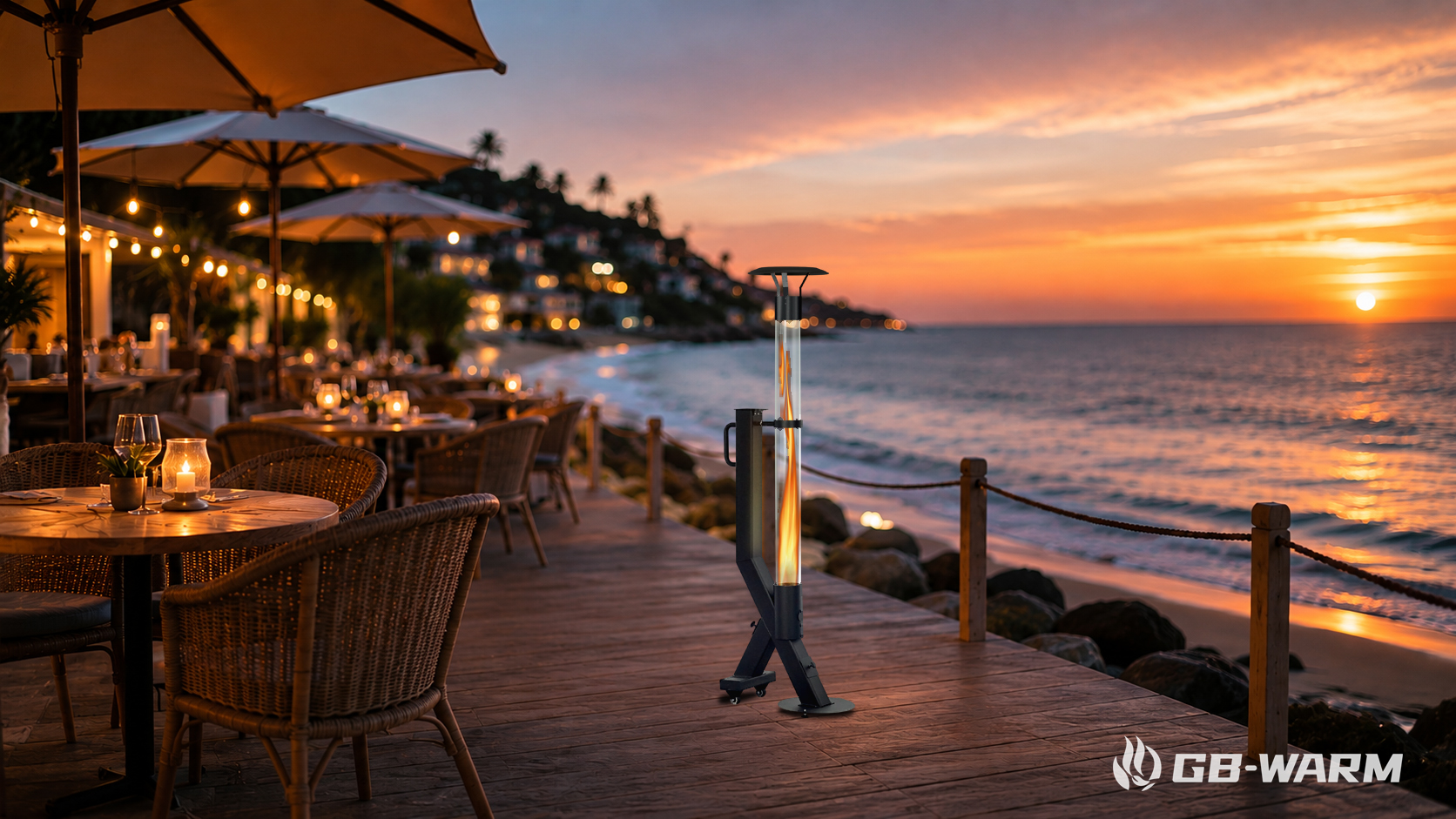
Why Are European Businesses Considering Wood Pellet Patio Heaters?
European hospitality businesses have traditionally used gas and electric patio heaters.
However, buyers are increasingly looking for alternative outdoor heating products that can offer a combination of:
A wood pellet patio heater offers a different proposition from conventional outdoor heaters.
Instead of using propane or electricity as the primary heating source, it burns compressed wood pellets to produce heat and a visible flame.
For restaurants and hotels, the flame can also contribute to the atmosphere of an outdoor dining area.
This makes pellet patio heaters particularly interesting for premium restaurants, cafés, bars, hotels, resorts, and outdoor hospitality businesses.
What Is a Wood Pellet Patio Heater?
A wood pellet patio heater is an outdoor heating appliance designed to burn compressed wood pellets.
The pellets are placed into a fuel hopper or chamber and are gradually supplied to the combustion area.
Depending on the design, the heater may include components such as:
Pellet hopper
Pellet feeding system
Combustion chamber
Ignition system
Heat-resistant glass
Flame chamber
Heat reflector
Ash collection system
Safety components
Different manufacturers use different combustion and feeding technologies.
For European buyers, the most important question is not simply how the heater looks, but whether the entire system can provide stable combustion, consistent heating performance, reliable operation, and manageable maintenance.
What Makes the Best Pellet Patio Heater for European Restaurants?
There is no single pellet patio heater that is best for every restaurant.
The right model depends on the restaurant's terrace size, operating hours, local climate, fuel availability, design requirements, and target customer.
However, European buyers should pay particular attention to the following factors.
1. Commercial-Grade Construction
A restaurant patio heater may operate for several hours every evening during the heating season.
This means commercial users need a product designed for frequent use.
When evaluating a manufacturer, ask about:
Do not evaluate a heater only from product photos.
A professional manufacturer should be able to explain the materials and construction used in the key components.
2. Pellet Consumption and Running Cost
For European commercial buyers, fuel consumption is one of the most important purchasing considerations.
The initial factory price is only part of the total cost.
A better calculation is:
Total Cost of Ownership = Purchase Price + Fuel Cost + Maintenance Cost + Spare Parts Cost
For example, if a heater consumes approximately 1 kg of pellets per hour and operates for five hours per day, the estimated fuel consumption would be approximately 5 kg per day.
Actual consumption depends on the specific model, heat setting, pellet quality, weather conditions, and operating environment.
Before placing an order, European importers should ask the manufacturer for clear information about:
Typical pellet consumption
Fuel hopper capacity
Approximate operating time
Recommended pellet specifications
Cleaning frequency
This information makes it easier to calculate the product's real operating cost in the target market.
3. Heating Performance
A commercial patio heater must provide meaningful warmth.
European buyers should ask manufacturers about the heater's:
However, heating area claims should be treated carefully.
Outdoor heating performance is affected by:
Therefore, buyers should look for practical performance information rather than relying solely on a single heating-area number.
4. Safety and European Compliance
Safety should be a priority when importing combustion-based heating equipment into Europe.
Before placing an order, importers should ask the manufacturer to provide the technical and compliance documentation applicable to the exact model.
Depending on the product design and target market, this may involve requirements relating to:
The exact requirements depend on the product configuration and destination country.
Important: European buyers should not simply accept a statement such as "CE certified."
Ask the supplier to provide the relevant Declaration of Conformity, test reports, technical documentation, and other applicable documents for the exact model being purchased.
A professional manufacturer should be able to clearly explain which requirements apply to the product.
5. Easy Operation for Restaurant Staff
Restaurant employees should not need extensive technical training to operate an outdoor heater.
The best commercial pellet patio heaters should ideally provide:
This becomes even more important when a restaurant operates five, ten, or twenty heaters simultaneously.
A complicated product can increase labor costs and create unnecessary operational problems.
For this reason, European importers should evaluate the user experience before placing a large wholesale order.
6. Easy Cleaning and Maintenance
Wood pellet combustion naturally produces ash and combustion residues.
Therefore, regular cleaning is part of normal operation.
For commercial customers, the cleaning process should be straightforward.
Ask the manufacturer:
How long does routine cleaning take?
Which components need regular cleaning?
How often should the heater be maintained?
Can restaurant staff perform routine maintenance themselves?
A well-designed heater should make these tasks as simple as possible.
Easy maintenance can help reduce downtime and extend the service life of the equipment.
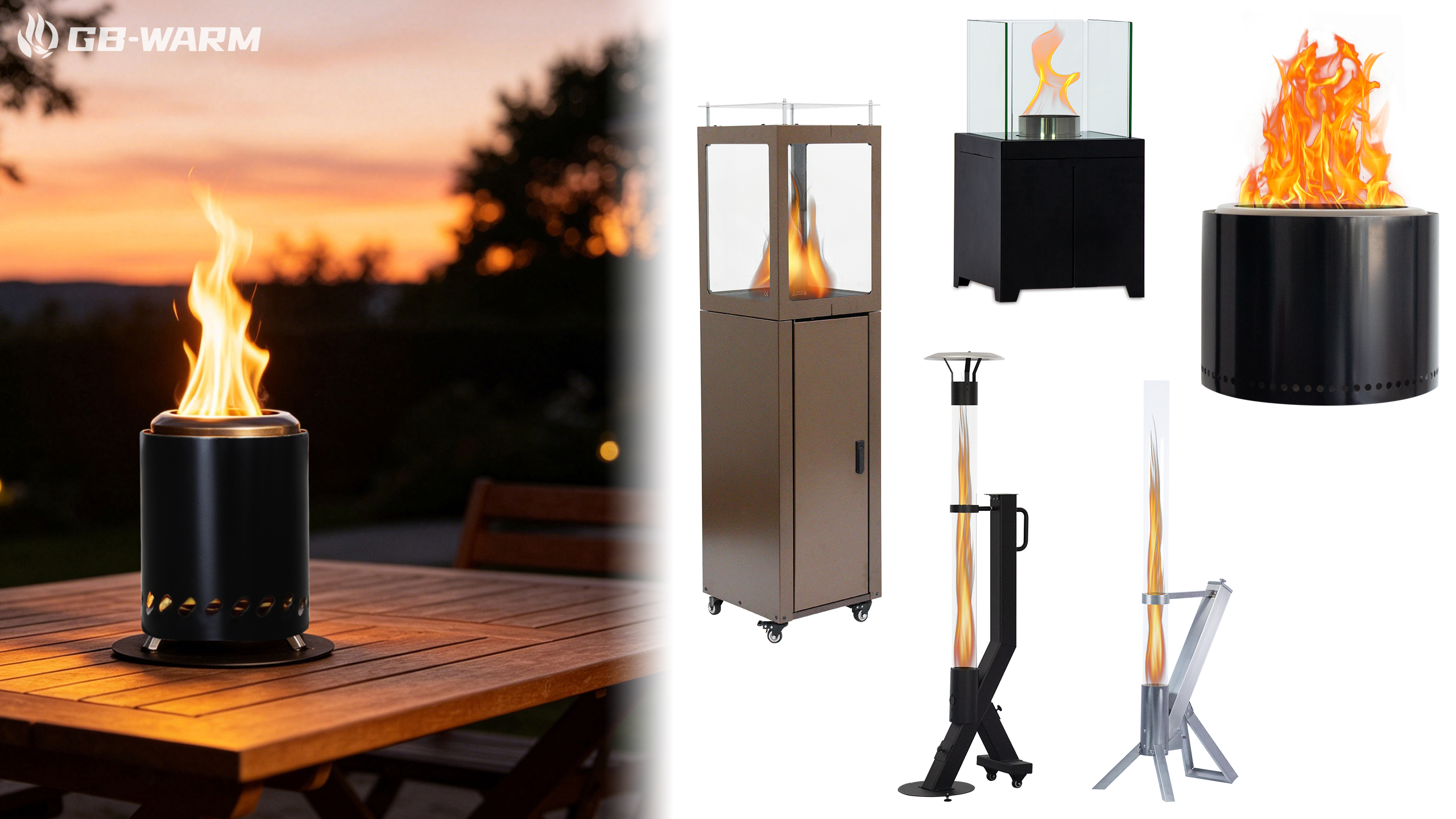
Wood Pellet Patio Heater vs. Gas Patio Heater
European buyers often compare pellet heaters with traditional gas patio heaters.
Both have advantages, but they provide different operating experiences.
| Feature | Wood Pellet Patio Heater | Gas Patio Heater |
| Fuel | Wood pellets | Propane / natural gas |
| Flame | Real wood-pellet flame | Gas flame |
| Fuel storage | Pellet bags | Gas cylinders / gas connection |
| Visual effect | Strong fire ambience | Traditional flame |
| Fuel loading | Manual pellet loading | Gas connection or cylinder |
| Maintenance | Ash and combustion cleaning | Burner and gas-system maintenance |
| Product differentiation | High | Relatively common |
| Commercial use | Yes | Yes |
For European distributors, product differentiation can be particularly important.
Gas patio heaters are already familiar in many markets.
A pellet patio heater can therefore provide a more distinctive product category for distributors looking to expand their outdoor heating portfolio.
How Many Pellet Patio Heaters Does a Restaurant Need?
This is another important question for European buyers.
The answer depends on:
Terrace size
Number of tables
Heater output
Outdoor temperature
Wind conditions
Seating arrangement
Desired comfort level
Instead of simply placing heaters around the perimeter, restaurants should think in terms of heating zones.
For example, one heater may serve a specific group of tables, while additional heaters are positioned to cover other seating zones.
This approach can provide more flexible heating and allow restaurant staff to adjust the number of operating heaters according to customer demand and weather conditions.
A professional manufacturer should be able to provide basic recommendations based on the application.
What Should European Importers Ask a Chinese Pellet Patio Heater Manufacturer?
If you are sourcing directly from China, do not make your decision based only on the quotation.
Before placing an order, ask the manufacturer the following questions.
Product Questions
How many years have you manufactured pellet patio heaters?
What is the typical pellet consumption?
What is the fuel hopper capacity?
What is the recommended pellet specification?
What is the expected heating performance?
How easy is the heater to clean?
What safety features are included?
Compliance Questions
Which European requirements does the product meet?
Can you provide the Declaration of Conformity?
Can you provide relevant test reports?
Are the documents applicable to the exact model?
Commercial Questions
What is the MOQ?
What is the sample price?
What is the production lead time?
What is your monthly production capacity?
What packaging options are available?
OEM Questions
Can you add our logo?
Can you customize the color?
Can you provide private-label packaging?
Can you customize the product or accessories?
After-Sales Questions
What spare parts are available?
How long is the warranty?
Can you provide technical support?
Can you provide installation and maintenance videos?
How do you handle quality problems after shipment?
A manufacturer that can answer these questions clearly is generally easier to evaluate than a supplier that only provides a product price.
Why OEM Is Important for European Distributors
Many European distributors do not want to compete by selling exactly the same product as every other supplier.
Instead, they want to create their own product identity.
This is where OEM and private-label manufacturing can become valuable.
A pellet patio heater manufacturer may be able to customize:
Logo
Product color
Packaging
User manual
Accessories
Control system
Product appearance
Product specifications
For distributors, this can help create a unique product line and strengthen their own brand.
Instead of competing only on price, they can compete through:
Product + Brand + Design + Service
Why Choose a Direct Manufacturer Instead of a Trading Company?
For European importers planning regular purchases, working directly with a manufacturer can provide several potential advantages.
Better Communication
Technical questions can be discussed directly with the factory's engineering and production teams.
More Flexible Customization
OEM and ODM projects are usually easier when the buyer communicates directly with the manufacturer.
Better Cost Control
Direct factory sourcing can reduce unnecessary intermediary costs.
Faster Problem Solving
Technical or quality issues can be communicated directly to the production team.
Better Long-Term Planning
A direct manufacturer relationship can support product development, forecasting, spare parts, and future orders.
However, European buyers should still conduct proper supplier due diligence before entering a long-term relationship.
For European importers and distributors, the ideal supplier is not simply the factory offering the lowest quotation.
The better question is:
Can this manufacturer consistently deliver the product, quality, documentation, customization, and support that my European customers expect?
GB-WARM focuses on pellet patio heater manufacturing and OEM/ODM solutions for international customers.
With extensive experience in pellet patio heater production and export, the company works with importers, distributors, wholesalers, and outdoor heating brands.
Key capabilities include:
For European buyers developing a new outdoor heating product line, direct communication with an experienced manufacturer can make the sourcing process more efficient.
European Buyer Checklist Before Placing a Bulk Order
Before confirming your purchase order, check the following:
Product
☐ Heating performance confirmed
☐ Pellet consumption confirmed
☐ Fuel specifications confirmed
☐ Product dimensions confirmed
☐ Materials confirmed
☐ Safety features confirmed
Compliance
☐ Applicable EU requirements identified
☐ Declaration of Conformity available
☐ Relevant test reports available
☐ Technical documentation available
☐ User manual available
Commercial
☐ MOQ confirmed
☐ Sample approved
☐ Production lead time confirmed
☐ Packaging confirmed
☐ Shipping terms confirmed
OEM
☐ Logo approved
☐ Color approved
☐ Packaging approved
☐ Manual approved
☐ Final artwork approved
After-Sales
☐ Spare parts list confirmed
☐ Warranty terms confirmed
☐ Troubleshooting information available
☐ Technical support confirmed
This checklist can help reduce the risk of unexpected problems after the goods arrive in Europe.
Final Thoughts: What Is the Best Wood Pellet Patio Heater for European Buyers?
The best wood pellet patio heater for restaurants, cafés, and hotels is not necessarily the cheapest product on the market.
For European buyers, the better choice is a product that offers a balanced combination of:
Commercial Durability
Stable Heating Performance
Reasonable Pellet Consumption
Easy Operation
Easy Maintenance
Appropriate Safety and Compliance
Attractive Design
OEM Capability
Reliable Manufacturer Support
For restaurants and hotels, the right heater can help create a more comfortable and attractive outdoor environment.
For European importers and distributors, it can also provide an opportunity to develop a differentiated outdoor heating product line.
The key is to evaluate the complete supplier package, rather than comparing factory prices alone.
A reliable manufacturer should be able to support you from the initial sample and product testing through production, documentation, shipping, spare parts, and after-sales service.
If you are sourcing wood pellet patio heaters wholesale from China for the European market, choosing an experienced manufacturing partner can be one of the most important decisions in building a successful outdoor heating business.
FAQ for European Buyers
1. Are wood pellet patio heaters suitable for the European market?
They can be suitable for European commercial applications, but the specific product must comply with the applicable requirements of the destination market. Importers should verify the documentation for the exact model before purchasing.
2. Can I import pellet patio heaters from China to Europe?
Yes, European companies can source pellet patio heaters from Chinese manufacturers. However, importers are responsible for ensuring that the product, documentation, labeling, and other requirements applicable to their market are properly addressed.
3. What should I ask a Chinese pellet patio heater manufacturer?
Ask about manufacturing experience, product testing, pellet consumption, safety, applicable compliance requirements, MOQ, lead time, OEM capability, spare parts, warranty, and after-sales support.
4. Can I order private-label pellet patio heaters?
Many manufacturers offer OEM and private-label services. Depending on the factory, customization may include logos, colors, packaging, manuals, accessories, and product specifications.
5. Are pellet patio heaters suitable for restaurants?
Yes. They can be used for suitable outdoor restaurant areas and can provide both heating and a real-flame ambience. The specific installation and operating requirements should always be checked for the destination market.
6. How can I choose a reliable pellet patio heater manufacturer?
Look beyond price. Evaluate manufacturing experience, factory capabilities, product quality, compliance documentation, testing, production capacity, OEM experience, spare parts availability, and communication.
7. What is the MOQ for wholesale pellet patio heaters?
MOQ varies by manufacturer and product model. Standard products may have different MOQs from customized OEM products. European buyers should ask for the MOQ for both samples and bulk orders.
8. How can I reduce my sourcing risk?
Start with samples, verify technical documentation, test the product in the intended application, confirm specifications in writing, inspect production before shipment when appropriate, and establish clear quality and warranty terms with the manufacturer.

 Español
 English
 العربية
 Français
 Русский
 Português
 Deutsch
 italiano
 Nederlands
 Polski
 Türkçe
 日本語
日本語 한국어
한국어 ဗမာစာ
ဗမာစာ தமிழ்
தமிழ் Bahasa Indonesia
 Čeština
 қазақ
қазақ Српски
 فارسی
فارسی Slovenčina
 Slovenščina
 Norsk
Norsk Svenska
 Ελληνικά
 Suomi
Suomi Latine
 Dansk
Dansk Shqip
Shqip বাংলা
বাংলা Hrvatski
 Gaeilge
 Eesti keel
 සිංහල
සිංහල नेपाली
 Oʻzbekcha
 latviešu
 Български
 ქართული
 ગુજરાતી
 íslenska
 ಕನ್ನಡ
ಕನ್ನಡ Lietuvių
 Lëtzebuergesch
 മലയാളം
 Malti
Malti मराठी
मराठी ଓଡ଼ିଆ
ଓଡ଼ିଆ پښتو
پښتو ਪੰਜਾਬੀ
 తెలుగు
 isiZulu