Imagine a restaurant terrace on a cool evening. Customers are enjoying dinner outdoors, a decorative flame creates a welcoming atmosphere, and the outdoor heating equipment helps make the space more comfortable.
Now imagine that smoke continuously blows toward the customers.
Even if the heater looks attractive, excessive smoke can negatively affect the outdoor dining experience. For homeowners, retailers, restaurants, hotels, and outdoor hospitality businesses, smoke performance is therefore an important consideration when choosing an outdoor heating product.
This leads to a common question: Do pellet patio heaters produce smoke?
The short answer is yes, wood pellet patio heaters can produce smoke, particularly during ignition or when combustion conditions are not ideal. However, a well-designed heater using suitable fuel under appropriate operating conditions can reduce visible smoke during normal burning.
For distributors, wholesalers, importers, and private-label brands, understanding this difference is essential before selecting products for your market.
At GB-WARM, we manufacture outdoor heating products, including wood pellet patio heaters and pellet fire pits. In this guide, we explain what causes smoke, which product features matter, how to evaluate smoke performance, and what buyers should know before placing a wholesale order.

1. Do Pellet Patio Heaters Produce Smoke?
Yes. Wood pellet patio heaters burn solid biomass fuel, so some smoke or visible emissions may occur during operation.
Wood pellets are generally made from compressed wood materials, such as sawdust and wood shavings. When heated and burned, they release energy through combustion. If combustion is incomplete, the process can also produce smoke, fine particles, and other emissions.
The amount of visible smoke varies depending on several factors:
The quality and moisture content of the wood pellets
The amount and distribution of combustion air
The design of the combustion chamber
The ignition method and operating conditions
Wind and other environmental conditions
The cleanliness and maintenance of the heater
A pellet heater designed to promote efficient combustion may produce less visible smoke than a poorly ventilated or improperly operated wood-burning appliance.
However, it is important to distinguish between low-smoke performance and completely smokeless operation.
A product marketed as a smokeless pellet heater should not automatically be assumed to produce zero emissions under every condition. Ignition, refueling, poor-quality fuel, and unfavorable airflow can all affect its performance.
For commercial buyers, the most useful question is not simply whether a heater produces smoke, but how consistently it performs under realistic operating conditions.
2. Why Do Wood Pellet Patio Heaters Produce Smoke?
Understanding the causes of smoke helps buyers identify which product features and operating instructions deserve attention.
2.1 Wet or Low-Quality Wood Pellets
Fuel quality is one of the most important factors affecting combustion.
Wood pellets with excessive moisture require more energy to heat and evaporate the water they contain. This can interfere with ignition and reduce combustion efficiency.
Pellets that break apart easily may also create excess fines and dust, potentially affecting fuel flow and airflow around the burning material.
For more predictable performance, users should choose pellets that meet the heater manufacturer's fuel specifications and store them in a dry, protected location.
For distributors, confirming the recommended pellet type is important when preparing product descriptions, instruction manuals, and customer support materials.
2.2 Insufficient Combustion Air
Wood pellets need oxygen to burn efficiently.
If airflow is restricted, the fuel may not burn as completely as intended, increasing the possibility of visible smoke and residue.
The design of the air inlets, combustion chamber, and internal airflow passages therefore plays an important role in combustion performance.
For manufacturers, airflow design is an important engineering consideration. For buyers, it is worth asking how the product is designed to support combustion and how users should keep the air passages clear.
2.3 The Ignition Stage
A pellet patio heater may produce more visible smoke during startup than after it reaches a stable burning condition.
During ignition, the fuel is heating up and the combustion process may not yet be fully established. This can result in temporary smoke.
This does not necessarily mean the heater is defective.
Nevertheless, startup behavior matters for products intended for restaurants, hotels, and other commercial applications where customers may be seated nearby.
When evaluating a potential supplier, ask for a demonstration of the heater from ignition through normal operation rather than judging its smoke performance from a short video showing only an established flame.
2.4 Poorly Designed Combustion Structures
Not all pellet patio heaters use the same combustion structure.
Some products feature a simple burning chamber, while others incorporate carefully arranged air passages or secondary-air systems intended to improve combustion.
Where a design supports more complete combustion, it may help reduce visible smoke under suitable conditions.
However, airflow technology alone does not guarantee smokeless operation. Its effectiveness depends on the complete product design, fuel characteristics, and operating conditions.
2.5 Wind and Environmental Conditions
Outdoor conditions also influence how smoke behaves.
Wind can change the airflow around a heater and push smoke toward nearby seating areas. Even when the heater is operating normally, its surroundings may make smoke more noticeable.
For restaurants and hospitality venues, product placement is therefore important. A suitable outdoor layout should consider prevailing wind direction, customer seating, nearby combustible materials, and the manufacturer's recommended clearances.
A heater's real-world performance should always be evaluated in the context of its intended application.
3. How Do Smokeless or Low-Smoke Pellet Patio Heaters Work?
Many outdoor pellet heaters are designed to minimize visible smoke by encouraging more effective combustion.
Although designs vary, several engineering principles are commonly relevant.
Improved Airflow
A suitable airflow arrangement helps supply oxygen to the burning pellets.
When air reaches the combustion zone effectively, the fuel can burn more consistently. This can reduce the incomplete combustion that contributes to smoke.
Secondary Combustion Air
Some designs introduce additional air into a hotter region above the primary burning area.
Under suitable conditions, this secondary air can help burn combustible gases and particles that would otherwise leave the combustion chamber unburned.
The actual results depend on temperature, airflow distribution, fuel quality, and chamber design.
Buyers should confirm whether a particular model incorporates this feature rather than assuming every pellet patio heater does.
Appropriate Combustion Chamber Design
The shape and arrangement of the combustion chamber affect how fuel burns and how gases move through the heater.
A well-designed structure can help maintain suitable burning conditions and support consistent flame performance.
For importers and private-label brands, these design details can help differentiate products within a competitive outdoor heating category.
Correct Fuel Selection
Even a well-designed heater cannot compensate for every fuel problem.
Using dry, suitable pellets helps support ignition and stable combustion. Users should avoid fuel types that are not approved by the manufacturer.
For buyers, the main lesson is simple: low-smoke performance depends on the complete heating system, not just one advertised feature.
4. What Are the Advantages of Low-Smoke Pellet Patio Heaters?
Reducing visible smoke can offer practical benefits for both end users and commercial operators.
A More Comfortable Outdoor Experience
Excessive smoke can interfere with dining, socializing, and relaxation.
A heater that performs well under normal operating conditions can help create a more comfortable environment around outdoor seating areas.
This is particularly important for restaurants, cafés, hotels, and event venues where customer comfort directly affects the overall experience.
An Attractive Flame Display
Many pellet patio heaters combine heating functionality with a visible flame.
For example, GB-WARM's BPH006 modern outdoor pellet heater features a cylindrical design and glass tube that displays the flame.
This style can appeal to customers who want an outdoor heater that also serves as a decorative focal point.
Easier Routine Cleaning
Combustion produces ash and other residue, even when a heater performs well.
A product designed for practical cleaning and maintenance can help users manage this residue more conveniently.
GB-WARM's pellet heater range includes different designs for outdoor heating and flame display. Buyers should compare each model's cleaning access, ash removal arrangements, and maintenance instructions before selecting products for their customers.
A Differentiated Product Offering
For distributors and retailers, smoke performance can be an important product-selection factor.
A well-supported low-smoke claim, combined with an attractive design and clear operating instructions, can help a product stand out in the outdoor living market.
However, marketing claims should accurately reflect the specific model's demonstrated performance.
5. How Does GB-WARM Approach Low-Smoke Pellet Heater Design?
When sourcing pellet patio heaters, buyers should look beyond product photographs and advertised features. The construction, fuel requirements, maintenance arrangements, and supporting technical information all matter.
GB-WARM offers several pellet heater designs through the official pellet patio heater collection.
Here are two examples worth exploring.
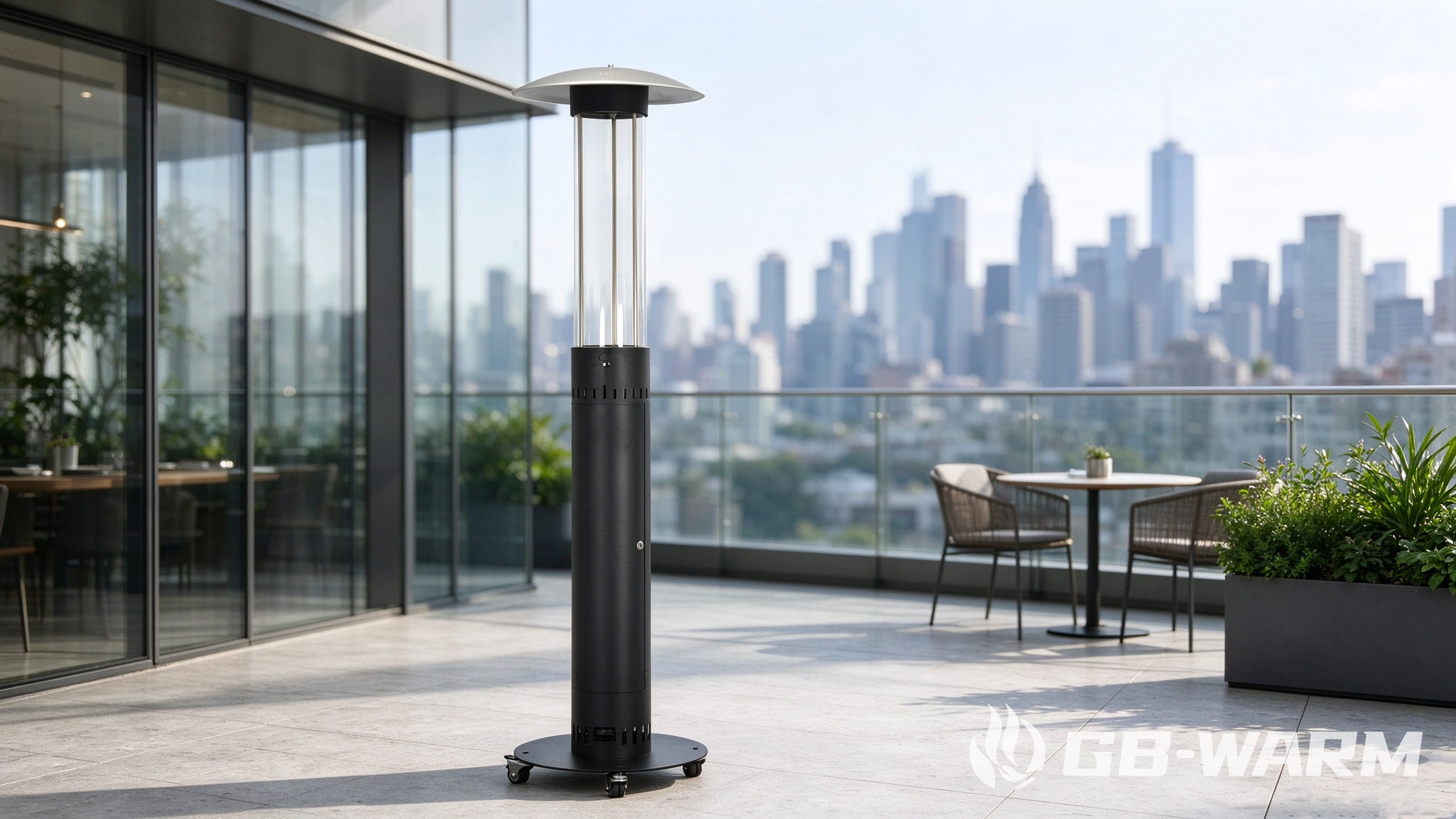
BPH006: Modern Glass-Tube Pellet Patio Heater
The BPH006 outdoor pellet heater features a tall cylindrical design and a glass tube that allows users to see the flame.
Its modern appearance may suit customers looking for a decorative outdoor heating product for patios, terraces, and hospitality environments.
When evaluating this model for wholesale purchase, buyers should request the current specifications, recommended fuel type, operating instructions, and available technical documentation.
BPH008-SS: Stainless Steel Pellet Fire Pit Heater
The BPH008-SS stainless steel pellet heater is another product in the GB-WARM range.
Its product page describes a stainless steel construction and an airflow design intended to promote combustion and reduce visible smoke.
This compact design may appeal to buyers exploring outdoor fire features and alternative pellet-burning products.
As with any low-smoke product, the expected performance should be assessed under the intended operating conditions. Buyers should request supporting test information if they need to substantiate specific smoke or emissions claims in their own markets.
Why Product-Specific Evaluation Matters
Different heater models can have different combustion structures, fuel capacities, dimensions, and intended applications.
A feature listed for one model should not automatically be attributed to the entire product range.
At GB-WARM, we encourage buyers to identify their preferred design and review the corresponding specifications before making a purchasing decision.
6. How Can Users Reduce Smoke When Operating a Pellet Patio Heater?
Proper operation is essential for getting the best performance from an outdoor pellet heater.
The following practices can help reduce avoidable smoke.
Use dry, suitable wood pellets. Follow the manufacturer's fuel specifications and protect pellets from rain and humidity.
Follow the correct ignition procedure. Use the recommended ignition method and allow the heater to establish combustion according to the operating instructions.
Keep airflow passages clear. Inspect the relevant openings and remove accumulated debris when the appliance is completely cool.
Clean the combustion chamber regularly. Excessive ash and residue may interfere with normal operation. Follow the maintenance instructions for the specific model.
Avoid overloading the heater. Load only the amount of fuel permitted by the manufacturer.
Position the heater appropriately. Consider wind direction, nearby seating, ventilation, and the specified clearance from combustible materials.
Inspect the heater for damage. Damaged components or blocked passages may affect combustion and should be addressed before further use.
These practices can help support more consistent operation, but they cannot guarantee zero smoke.
Pellet patio heaters are designed for outdoor use only. Never operate one in an enclosed room, garage, tent, or other enclosed space, because combustion can produce carbon monoxide and create serious fire and health hazards.
7. What Should Wholesale Buyers Check Before Ordering Low-Smoke Pellet Heaters?
For importers, distributors, retailers, and private-label brands, evaluating a pellet patio heater requires more than comparing purchase prices.
The following checklist can help you assess a potential supplier.
1. Smoke Performance Evidence
Ask how the manufacturer evaluates smoke performance.
If low-smoke performance is a major selling point, request relevant test data or a demonstration covering startup and normal operation. Clarify the test conditions and whether the evidence applies to the exact model you plan to purchase.
2. Fuel Specifications
Confirm the recommended pellet dimensions, moisture requirements, and any other fuel restrictions.
This information helps you determine whether the product is practical for your target market.
3. Product Materials and Construction
Ask about the materials used for the housing, combustion components, glass parts where applicable, and surface finishes.
Also confirm the expected maintenance requirements and availability of replacement components.
4. Applicable Compliance Requirements
Product requirements vary by country and product category.
Before placing an order, confirm the applicable safety standards, testing requirements, labeling rules, and documentation for your destination market.
Request certificates and test reports for the specific model and configuration rather than assuming that one document covers every product.
5. OEM and ODM Options
If you sell under your own brand, ask about logo application, packaging customization, color options, and potential design modifications.
Confirm minimum order quantities, additional costs, production lead times, and which changes are technically feasible.
6. Quality Control and After-Sales Support
Ask about pre-shipment inspections, packaging, warranty terms, and replacement-part availability.
For commercial products, clear operating instructions and practical maintenance support can help reduce problems after delivery.
Evaluating these factors helps buyers make better-informed sourcing decisions and build a more reliable outdoor heating product portfolio.
GB-WARM, manufactures patio heaters and other outdoor living products for international customers.
Our website describes an approximately 15,000-square-meter factory, a range of outdoor heating products, and manufacturing and inspection capabilities.
For buyers interested in pellet patio heaters, we offer several designs to explore, including glass-tube heaters, cylindrical models, and compact pellet-burning products.
Working directly with a manufacturer gives buyers an opportunity to discuss product requirements with the team responsible for production.
Depending on the model and project requirements, discussions may cover:
Product selection and technical specifications
Logo and packaging customization
Color and finish options
Order quantities and production arrangements
Quality inspection requirements
Shipping and after-sales support
For importers and distributors, these discussions help establish whether a product is suitable for the intended market before a bulk order is placed.
If smoke performance is a priority for your customers, tell us at the inquiry stage. We can discuss the available models, relevant product information, and the technical details you need to evaluate your options.
Explore the GB-WARM pellet patio heater collection to compare available designs.
9. Frequently Asked Questions About Pellet Patio Heater Smoke
Are pellet patio heaters completely smokeless?
Not necessarily. Some models are designed to reduce visible smoke, but smoke can still occur during ignition, with unsuitable fuel, or under unfavorable combustion conditions. Buyers should evaluate the performance of the specific model rather than relying on the term "smokeless" alone.
Why does my pellet patio heater smoke when starting?
During ignition, the pellets may not yet be burning under stable conditions. Temporary smoke can occur as the fuel heats up. Follow the manufacturer's ignition procedure and investigate persistent or unusually heavy smoke before continuing operation.
Do wood pellets produce less smoke than firewood?
The result depends on fuel quality, moisture content, combustion design, and operating conditions. Dry, suitable wood pellets burned in a well-designed appliance may produce less visible smoke than poorly seasoned firewood in an inefficient fire pit, but this is not a universal guarantee.
Does a smokeless pellet heater produce ash?
Yes. Burning wood pellets produces ash, although the quantity varies with the fuel and operating conditions. Regular cleaning remains necessary even for products marketed as smokeless.
Are low-smoke pellet patio heaters suitable for restaurants?
They may be suitable for outdoor dining areas when the product meets the venue's heating and safety requirements. Buyers should evaluate smoke performance, wind exposure, seating layout, fuel handling, maintenance, and applicable local regulations.
Can GB-WARM supply pellet patio heaters for wholesale orders?
GB-WARM offers a range of pellet patio heater products for business buyers. Contact our team to discuss available models, order quantities, technical specifications, and potential OEM/ODM requirements.
Conclusion: Choose the Right Pellet Patio Heater for Your Market
Do pellet patio heaters produce smoke? Yes, they can. However, the amount of visible smoke depends on fuel quality, combustion design, airflow, ignition, maintenance, and environmental conditions.
For buyers, the best approach is to look beyond the word "smokeless" and evaluate the product's actual performance, technical specifications, and suitability for its intended application.
For distributors, wholesalers, and private-label brands, a well-designed pellet patio heater with clearly documented operating requirements can offer an attractive addition to an outdoor living product range.
GB-WARM offers a variety of pellet patio heater designs for businesses looking to expand their outdoor heating selections.
Looking for a pellet patio heater manufacturer for your next wholesale order?
Visit our Pellet Patio Heater Collection to explore available models.
Contact GB-WARM to request product information, discuss low-smoke performance requirements, explore customization options, and obtain a quotation for your project.
Let's work together to bring distinctive outdoor heating products to your market.

 Español
 English
 العربية
 Français
 Русский
 Português
 Deutsch
 italiano
 Nederlands
 Polski
 Türkçe
 日本語
 한국어
 ဗမာစာ
 தமிழ்
 Bahasa Indonesia
 Čeština
 қазақ
 Српски
 فارسی
 Slovenčina
 Slovenščina
 Norsk
 Svenska
 Ελληνικά
 Suomi
 Latine
 Dansk
 Shqip
 বাংলা
 Hrvatski
 Gaeilge
 Eesti keel
 සිංහල
 नेपाली
 Oʻzbekcha
 latviešu
 Български
 ქართული
 ગુજરાતી
 íslenska
 ಕನ್ನಡ
 Lietuvių
 Lëtzebuergesch
 മലയാളം
 Malti
 मराठी
 ଓଡ଼ିଆ
 پښتو
 ਪੰਜਾਬੀ
 తెలుగు
 isiZulu